
On Wednesday, July 12, 2006, the 2006 National Student Conference was held at the Marriott Wardman Park Hotel in Washington, DC by Campus Progress. The interns from the Center for American Progress were expected to be at the hotel around 6:30A.M., to help set up and prepare for registration for the participants for the conference. I arrived at the conference at 8:00A.M., I had overslept from the screening of "The Trials of Darryl Hunt" the night before.

When I arrived at the conference I jumped right in where ever I was needed. I helped out with registration and other things. I then went to get my badge and it had a red star to the left of my name and I was told it was there because I was speaking at the conference. After most of the people had arrived to the hotel we were able to go in the ballroom to hear the Morning Plenary. I was able to hear Adrienne Maree Brown, Executive Director of Ruckus Society and the end of Reverend Dr. James Alexander Forbes, Jr., the Senior Minister of The Riverside Baptist Church in New York. I did not get to sit in on the first panel discussion because I was helping the attendees and the people that where "manning" the tables. I also had to get ready for the Luncheon Program.


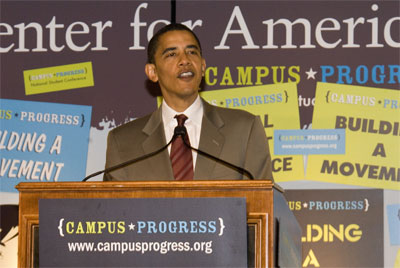
The Luncheon Program began at 12:05P.M. It began with Hollie Russon Gillman introducing Paul Begala, Political Analyst and CNN Commentator. Paul Begala spoke for about 10 minutes and then began presenting the Campus Progress Awards. After he had presented all of the awards, I went on stage to introduce the President and CEO of the Center for American Progress. Once I finished, John Podesta came on stage, thanked me and others and began speaking. He in turn introduced Lauren Patrizi, a student from Loyola University

Chicago that was introducing the keynote speaker, United States Senator Barack Obama. I had to leave while Senator Obama was speaking to make sure my panel was set-up and ready when the attendees were let out of the Luncheon Program.
My first panel discussion **The New Muckrakers** was composed of
Emily Biuso, Intern

Coordinator, The Nation;
Josh Kalven, Senior Researcher, Media Matters for America;
Justin Rood, Blogger, TPMMuckraker.com;
Laura Rozen, Senior Correspondent, The American Prospect, Blogger, WarandPiece.com; and
Amanda Terkel (Moderator), Research Associate, ThinkProgress.org, Center for American Progress. During this panel after I had counted the number of people that were in the room I stepped out to finish my lunch. When I came back to panel and at that time they were taking questions from the audience. I stayed about 10 minutes and I told the other person that I was working with for the day that I was going to make sure everything was set-up for our next panel.
The second panel

discussion **Beyond the Great Society** was composed of
Richard P. Applebaum, Professor of Sociology and Global and International Studies, University of California at Santa Barbara;
Mark Greenberg, Executive Director, Task Force on Poverty, Center for American Progress;
Jen Kern, Director, ACORN Living Wage Resource Center;
Almas Sayeed, Congressional Hunger Research Fellow, Center for American Progress; and
Cassandra Q. Butts (Moderator), Senior Vice President for Domestic Policy, Center for American Progress. I sat in on almost the entire panel. It was very interesting and it consisted of three people from the Center for American Progress, where I'm doing my internship for the new readers. When the question part of the panel came up I was the person with the microphone and I chose most of the people who asked the questions. I left around 15 minutes early to set-up for the next panel.
The third and final panel discussion **Is It Bigger Than Hip-Hop?** was comp

osed of
Joseph "Fat Joe" Cartagena, Rapper, Actor, and Entrepreneur;
Bakari Kitwana, Director of Rap Sessions: Community Dialogues on Hip Hop, and Author of The Hip Hop Generation;
Alexis McGill, Executive Director, Citizen Change;
Amina Norman-Hawkins, President, Chicago Hip Hop Initiative;
Billy Wimsatt, Executive Director, League of Young Voters; and
Jeff Johnson (Moderator), Senior Advisor for Youth and Urban Outreach, People For the American Way. I was there to count all of the people that were attending the panel. Once the majority of

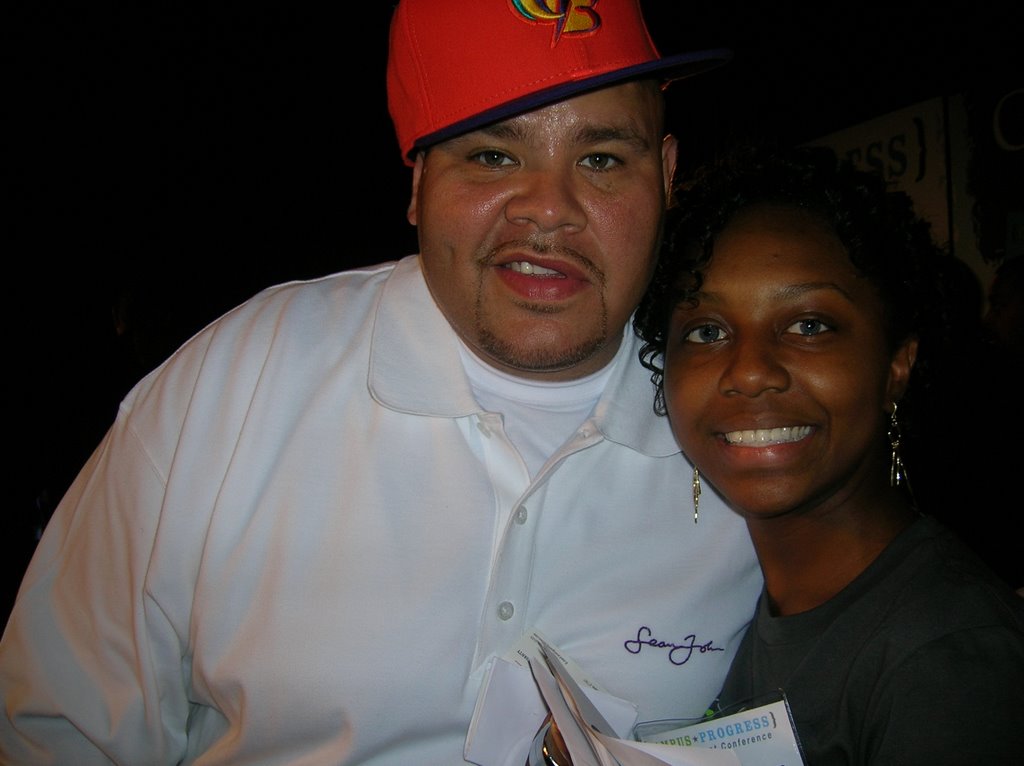
the people were seated I asked another person from the Center for American Progress to monitor the door so I could go change clothes. By the time I had come back into the panel they had just begun and the moderator was introducing people. This by far was the most interesting panel, because all of the remarks that were made by both the panelists and the audience. As you can see I was able to meet and take a picture with Fat Joe and Cousin Jeff. I was able to hear the beginning of the Closing Plenary, where United States Representative Tammy Baldwin spoke. I used the conference as a networking opportunity. It was amazing for me. While I was walking around

during the panels or going to my next panel various people were coming up to me and introducing themselves. I was proud of myself because obviously these people saw something in me and they wanted me to know them. This was an opportunity of a lifetime and I am glad I took full advantage of it. Some of the people I met at the conference will be people I will keep in contact with for years to come.
2006 National Student Conference was a blast!!!





 As you can see from the email we lost but we put up a good fight. I'm glad I could help my team in our fight towards victory. Even though we did not win we had a really good time playing and it was a really good opportunity for us to bond with our fellow interns and some of the staff. Everyone had fun being both a participator and a spectator. I might have to join a softball team back home... It's just a thought.


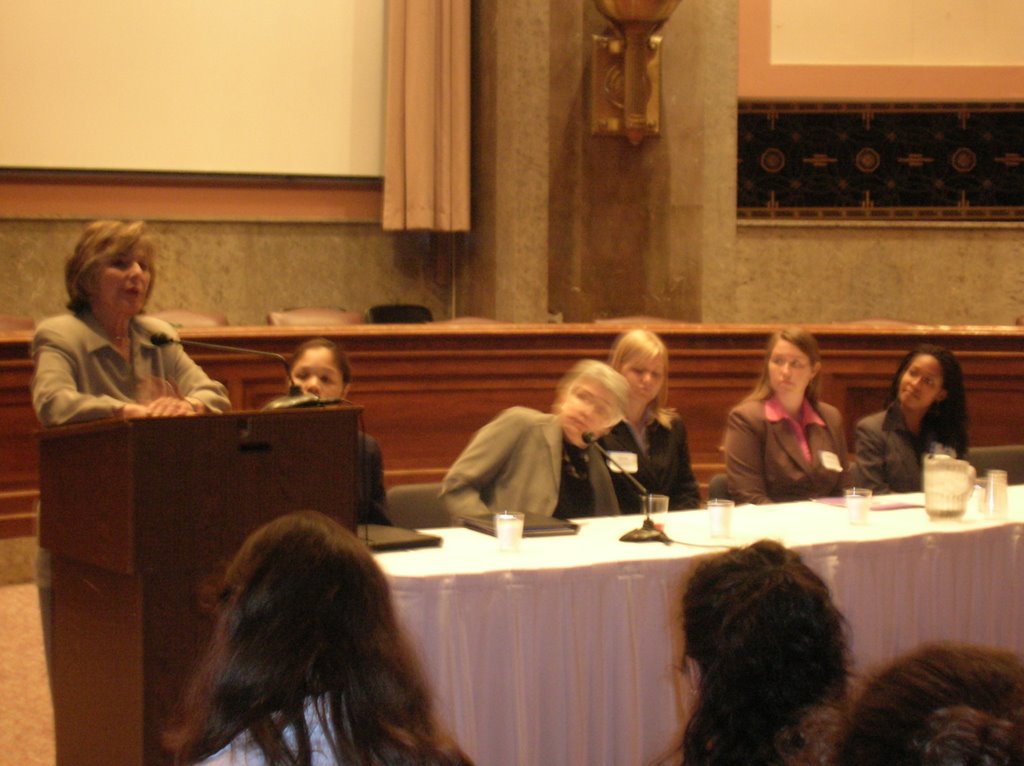
 The event was a forum on the feminization of power and a discussion of the rewards and challenges women experience while striving for leadership roles from campus to congress. "Taking the Lead: from Campus to Congress" focused on encouraging women's participation in campus, local, and national politics. The forum discussed the rewards and challenges that women face on the road to public office. Too often women are not encouraged to seek leadership on campuses and beyond. We can break through the 'glass ceiling' with positions on student government, campus newspapers, and as leaders of campus groups. Then we can use the experiences gained to spark a lifelong interest in public service and political office. Campus models where feminists have united with supportive groups to run a successful slate were also discussed. With this event, the Feminist Majority Foundation hoped to support current campaigns and launch future ones. The speakers included:
  All of the women on the panel told different stories about why they became involved with politics and/or leadership. I could really relate to the story told by Jennifer Owens. She talked about being involved with a campaign her freshman year and continued to work with the Student Association at Howard. Owens then said everyone continued to tell her that she was going to do this and that are far as leadership. She thought they were just talking. Owens later questioned herself, "If everyone else can see it in me, why can't I see it in myself?" I feel the exact same way. I am glad I got to hear her story it was beneficial to me and has helped me embrace the new responsibilities that are thrown my way!


 A wall of various signs





 In 1984, a young white newspaper reporter, Deborah Sykes, was raped, sodomized and stabbed to death just blocks from where she worked in Winston-Salem, NC. Base on an ID made by a former Klan member, a 19-year-old black man, Darryl Hunt, was charged. No physical evidence linked Hunt to the crime. Hunt was convicted by an all white jury, and sentenced to life imprisonment. In 1994, DNA testing cleared Hunt, yet he would spend another ten years behind bars. The film chronicles this capital case from 1984 through 2004. With personal narratives and exclusive footage from two decades, the film frames the judicial and emotional responses to this chilling crime - and the implications surrounding Hunt's conviction - against a backdrop of class and racial bias in America. This unique look at one man's loss and redemption challenges the assumption that all Americans have the right to unbiased justice.
  The panel discussion that followed the movie featured Darryl Hunt; Mark Rabil, Darryl Hunt’s attorney; Nkechi Taifa, senior policy analyst at Open Society Policy Center; and Clyde Williams, Center for American Progress. The movie was very moving. At a few points in the movie, I was brought to tears. I think everyone should watch this movie when it comes out, but especially the people who have lived in the South at one point in their lives. Being a native of North Carolina, I was shocked that I had never heard of his story. This is one reason I chose to pursue a career in the legal system, to try to make a positive impact on at least one person’s life. I know that Darryl Hunt's case is not the only case like this. During the discussion Darryl was asked about his faith and how it was strengthened throughout his prison sentence. He told the audience that his grandparents instilled Christian beliefs in him at a young age, by making him attend church every Sunday. After the screening and discussion had come to an end, I had a chance to speak to the entire panel and the director of the movie. I really enjoyed this movie and I am glad I had the privilege to view the movie before it airs on HBO.


 In the discussion brought up four key points that are needed for democracy: Level of Tolerance, between competition; Respect of the Rule of Law, a good example is Russia; Leadership, without it you can not have a democracy; Participation, the degree people get engaged/they will give a lot more. He stated that for when running for political office the "Less time, [the] more money you need". Senator Daschle then explained how a congressman is divided. The Natural, legislator (8,000 votes in 4 terms); Ambassador of your state, foreign travel and economic trade; Political Leader, encourage participation; Service to your state. As a Senator, your priorities are broken down to Washington, State and Home. Some senators' priorities fall in that order also. Senator Daschle felt that family should come first. While on the subject of family he made the following statement: "If your kids become more of a liability to society than an asset, then all the rest of it [statesmanship] doesn't matter. And you only have one shot at raising them."